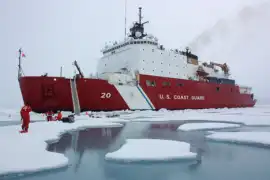
The Impacts of Climate on the Eco-Systems and Chemistry of the Arctic Pacific Environment (ICESCAPE) was a field investigation aimed at studying how climate change affects the biogeochemistry and ecology of the Chukchi and Beaufort Seas. ICESCAPE had two deployments in 2010 and 2011 during the boreal summer. Ship and ice stations were used to measure ice properties and morphology. ICESCAPE was part of the Ocean Biology and Biogeochemistry and Cryosphere programs.
Conductivity, Temperature, and Depth (CTD) sensors are in situ instruments that measure water depth, pressure, salinity, temperature, and density in the ocean. CTD sensors can be deployed on various water-based platforms, including autonomous underwater vehicles (AUVs), buoys, gliders, and research vessels. When mounted on a vessel, CTD sensors are typically attached to a rosette and lowered to the seafloor to record water properties. These sensors typically sample at 30 Hz and can provide accurate measurements at specific water depths, tailored to the researcher's needs.
Earth Science > Oceans > Ocean Pressure > Water Pressure
Earth Science > Oceans > Bathymetry/seafloor Topography > Water Depth
Earth Science > Oceans > Ocean Temperature > Water Temperature
Earth Science > Oceans > Salinity/density
Generic-Atmospheric State (Gen-AtmsState) refers to non-specific instruments on a platform that measure atmospheric state parameters. These are typically in situ sensors that measure temperature, pressure, humidity, and wind speed and direction. Types of atmospheric state instruments include thermometers, hygrometers, barometers, and anemometers.
Earth Science > Atmosphere > Atmospheric Water Vapor
Earth Science > Atmosphere > Atmospheric Pressure
Earth Science > Atmosphere > Atmospheric Water Vapor > Water Vapor Indicators > Humidity
Earth Science > Atmosphere > Atmospheric Temperature > Surface Temperature > Air Temperature
Generic-Chemistry Related Sensors (Gen-Chemistry) refers to non-specific instruments on a platform used for atmospheric chemistry measurements. These are typically in situ analyzers that measure chemical compounds such as trace gases, halocarbons, volatile organic compounds, nitrates, aerosols, and other chemical species. Measurements can include mixing ratios, composition, particle size, optical properties, and particle size distribution.
The Acoustic Doppler Current Profiler (ADCP) is an acoustic sensor that measures ocean currents. It uses the Doppler effect to detect sound waves, providing measurements of current speed and direction throughout the water column. It can be easily mounted on various water platforms, such as ships, buoys, and autonomous underwater vehicles (AUVs). It can also be deployed on the seafloor to provide profiles of ocean currents.
The PRR-800 High-Resolution Profiling Reflectance Radiometer is a water-based profiling radiometer manufactured by Biospherical Instruments, Inc. It collects profiles of underwater radiance and irradiance for ocean color research. It operates across the 340-900 nm spectral range with a bandwidth of 10 nm. The PRR-800 has a depth range of 350 m and a maximum data rate of 15 Hz.
Earth Science > Oceans > Ocean Optics > Ocean Color
Earth Science > Oceans > Ocean Optics > Radiance
Fluorometers are water-based sensors that measure fluorescence patterns. They provide measurements of chlorophyll-a fluorescence, optical backscatter, and colored dissolved organic matter (CDOM) in seawater. They are typically used to assess chlorophyll concentrations and determine phytoplankton concentrations in the ocean. Fluorometers can be deployed on research vessels, buoys, autonomous underwater vehicles, and other water-based platforms.
The LISST Submersible Particle Size Analyzer is a water-based, in situ particle analyzer manufactured by Sequoia Scientific. It uses laser diffraction to measure suspended particle size and concentration in aquatic environments, including the ocean, rivers, lakes, and streams. It provides particle size distribution from 1 μm to 500 μm across 36 size ranges. It has a maximum operating depth of 600 m, a resolution of 0.01 m, and a typical sampling rate of 1 Hz. The instrument's laser operates at 670 nm with an optical path of 25 mm.
Photosynthetically Active Radiation (PAR) sensors are in situ optical devices used to study photosynthesis and plant physiology. They detect light between 400 and 700 nm and convert it into signals for PAR measurement. PAR sensors can be mounted on ground- or water-based platforms or be portable and handheld. They are primarily used in agriculture, such as monitoring crop growth and analyzing light distribution in plant canopies, but they are also employed to study phytoplankton and aquatic productivity.
Earth Science > Biosphere > Vegetation > Photosynthetically Active Radiation
Spectrophotometers are passive photometers that measure the intensity of light transmitted through a sample solution as a function of the wavelength of electromagnetic radiation. They are typically used for ground-based or shipborne observations. They can operate in the ultraviolet-to-visible (185-700 nm) or infrared (700-15000 nm) spectral ranges. They are commonly used in vegetation studies, air pollution monitoring, and water and soil quality analysis.
The Submersible Biospherical Optical Profiling System (SuBOPS) is a water-based in situ sensor that measures water's apparent optical properties (AOPs). The optical profiler is mounted on a kite-like free-fall backplane and descends through the water at speeds less than 20 cm per second to measure AOPs. It operates across 19 channels spanning 320 to 860 nm with a 10 nm full-width at half maximum bandwidth. SuBOPS has a vertical resolution of less than 1 cm and a data acquisition rate of 12 Hz. It has collected vertical profiles in temperate and arctic waters at depths of less than 3 m.
Conductivity, Temperature, and Depth (CTD) sensors are in situ instruments that measure water depth, pressure, salinity, temperature, and density in the ocean. CTD sensors can be deployed on various water-based platforms, including autonomous underwater vehicles (AUVs), buoys, gliders, and research vessels. When mounted on a vessel, CTD sensors are typically attached to a rosette and lowered to the seafloor to record water properties. These sensors typically sample at 30 Hz and can provide accurate measurements at specific water depths, tailored to the researcher's needs.
Earth Science > Oceans > Ocean Pressure > Water Pressure
Earth Science > Oceans > Bathymetry/seafloor Topography > Water Depth
Generic-Chemistry Related Sensors (Gen-Chemistry) refers to non-specific instruments on a platform used for atmospheric chemistry measurements. These are typically in situ analyzers that measure chemical compounds such as trace gases, halocarbons, volatile organic compounds, nitrates, aerosols, and other chemical species. Measurements can include mixing ratios, composition, particle size, optical properties, and particle size distribution.
Conductivity, Temperature, and Depth (CTD) sensors are in situ instruments that measure water depth, pressure, salinity, temperature, and density in the ocean. CTD sensors can be deployed on various water-based platforms, including autonomous underwater vehicles (AUVs), buoys, gliders, and research vessels. When mounted on a vessel, CTD sensors are typically attached to a rosette and lowered to the seafloor to record water properties. These sensors typically sample at 30 Hz and can provide accurate measurements at specific water depths, tailored to the researcher's needs.
Earth Science > Oceans > Ocean Pressure > Water Pressure
Earth Science > Oceans > Bathymetry/seafloor Topography > Water Depth
Earth Science > Oceans > Ocean Temperature > Water Temperature
Earth Science > Oceans > Salinity/density
Salinometers are in situ instruments that measure the salinity of water. Most salinometers determine salinity by measuring the electrical conductivity of the water sample. They are portable and provide continuous, real-time, precise salinity measurements. Salinometers are used for oceanographic research, water quality management, and industrial processes.
Generic-Atmospheric State (Gen-AtmsState) refers to non-specific instruments on a platform that measure atmospheric state parameters. These are typically in situ sensors that measure temperature, pressure, humidity, and wind speed and direction. Types of atmospheric state instruments include thermometers, hygrometers, barometers, and anemometers.
Earth Science > Atmosphere > Atmospheric Water Vapor
Earth Science > Atmosphere > Atmospheric Pressure
Earth Science > Atmosphere > Atmospheric Water Vapor > Water Vapor Indicators > Humidity
Earth Science > Atmosphere > Atmospheric Temperature > Surface Temperature > Air Temperature